




























































How to Write a Character Card That Holds Up
Card quality decides whether a character holds up, not model quality. What each field actually does, and the mistakes that flatten a character by turn twenty.
When a character goes flat by turn twenty, people blame the model. It is almost always the card. A tight card will hold a believable identity on a modest model, and a vague one will dissolve on the best model money can buy.
What each field is actually for
Most cards fail because the writer treats every field as a place to put more information. They do different jobs, and the model weighs them differently.
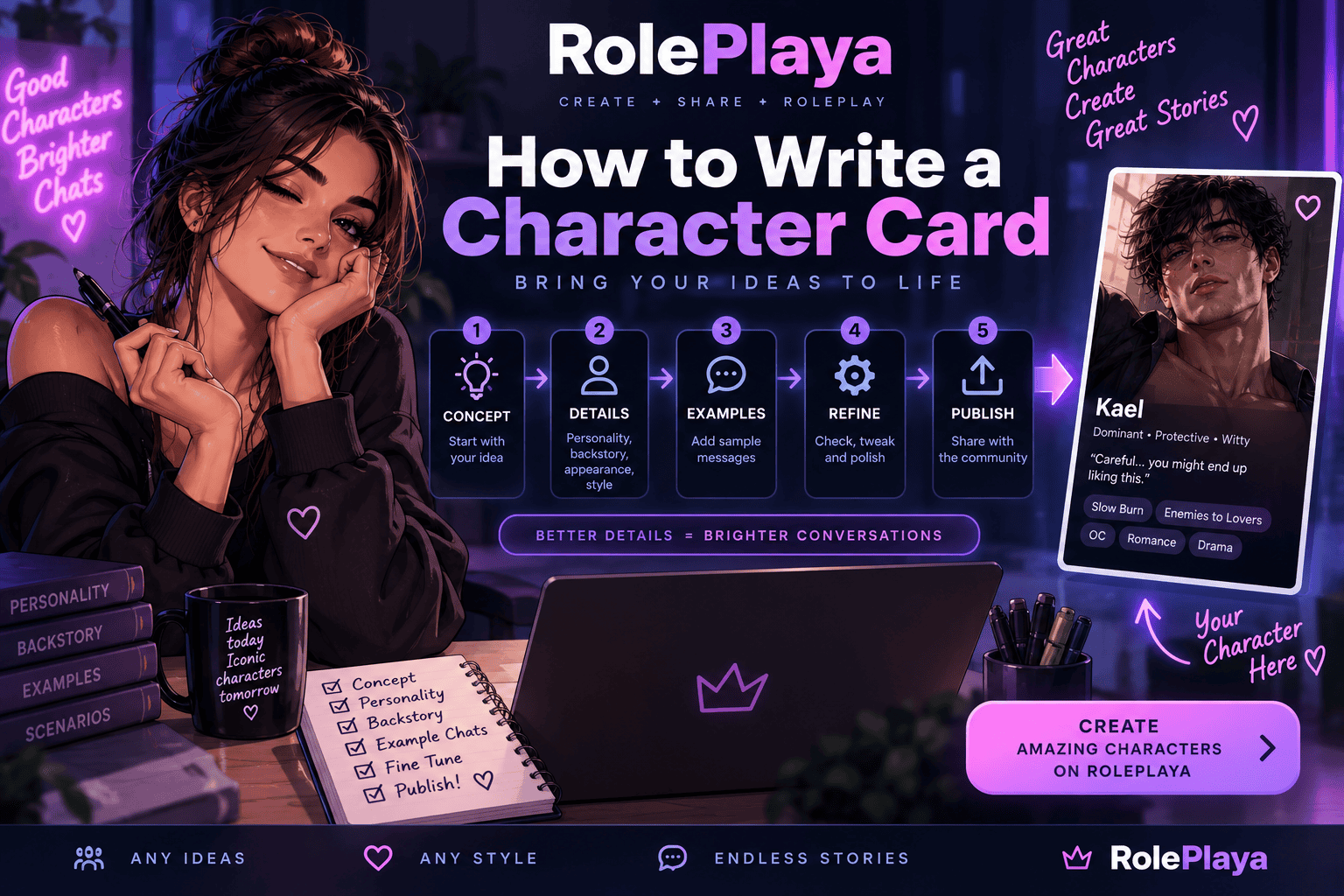
| Field | Job | Who sees it |
|---|---|---|
| Intro | The pitch. It decides whether someone opens the chat at all. | Public, 500 characters |
| Greeting | The master example. The model copies its style for the whole session. | Public, 1000 characters each |
| Background | The brain. Traits, history, relationships, rules of behaviour. | Private, 10,000 characters |
| Dialogue examples | Voice. How this person talks when nothing dramatic is happening. | Private, up to 10 |
| Tags | Discovery only. No effect on behaviour. | Public, up to 10 |
The single most common mistake is writing the pitch in the background field. Marketing language teaches the model nothing about how to act.
Write behaviour, not adjectives
"Sarcastic" is not instruction. It is a label, and the model will average it against every sarcastic character in its training data, which produces a generic smirking archetype rather than your person.
Behaviour is specific and testable. "Answers direct questions with a question of her own when she is uncomfortable" tells the model what to do and when to do it. Aim for that shape throughout: a trait, the trigger, and the visible result.
Applies to physical detail too. A scar means nothing unless the card says she touches it when she lies.
Tight beats long
You have ten thousand characters. Using all of them is usually a mistake. Everything on the card competes with the live conversation for the model attention, and the more padding there is, the more the specific instructions get diluted by the general ones.
A focused few hundred words of concrete traits outperforms a two thousand word biography almost every time. If a sentence would not change how the character behaves in a scene, cut it.
Say what the character does, not what it must not do
This is the least intuitive rule and the one with the biggest effect. Negative instructions tend to backfire, because naming a behaviour puts it in front of the model regardless of the word wrapped around it. Write "keeps replies to two or three paragraphs" rather than telling it not to ramble. Write "speaks plainly, in short sentences" rather than forbidding flowery prose.
Every prohibition on a card is better rewritten as the positive behaviour you actually want.
The greeting is doing more work than you think
The model treats your opening message as the definitive example of how this character writes. Length, tense, point of view, how much narration versus speech, whether actions sit in italics: all of it gets mirrored back for the rest of the session.
So write the greeting last, once the voice is settled, and make it look exactly like the replies you want. Three things to get right:
- Leave space. A greeting that resolves the situation gives the other person nothing to do. End on a question, a decision, or an interruption.
- Stay out of the reader head. Never write what the user thinks, feels or does. The moment a card does that, the model assumes it has permission to keep doing it, and the session stops being a conversation.
- Set the scene in one breath. Where, when, what mood, and why the other person is there.
Additional greetings are worth the effort. They give the same character several entry points and a reason to be replayed.
Dialogue examples are where voice lives
Descriptions tell the model who the character is. Examples show it how they sound. Two or three ordinary exchanges, not dramatic ones, will do more for consistency than another paragraph of backstory.
Write them at the temperature of a normal moment. If every example is a confrontation, the model learns that this character is always confrontational.
Placeholders
Use {char} for the character name and {user} for whoever is chatting. The double brace form {{user}} also works, so cards written elsewhere carry over without editing. Placeholders matter more than they look, because a card that hardcodes one name reads as broken to everybody else who opens it.
Test it properly
Twenty turns is the honest test. Most cards survive five. What you are watching for:
- Drift. The voice slowly turning into the same neutral assistant voice. Fix it with more example dialogue, not more adjectives.
- Mirroring. The character adopting your speech patterns rather than keeping their own. Usually a sign the card describes rather than demonstrates.
- Speaking for you. Almost always traceable to a greeting that narrated the user.
- Repetition. Often a card with one idea in it, repeated in three different ways, so the model has nothing else to draw on.
When something is wrong, fix the card and start a fresh chat. Correcting the character inside the conversation teaches it nothing, because the card is what loads next time.
Build one and see
The RolePlaya creator has separate fields for intro, multiple greetings, background and dialogue examples, so the structure above maps onto it directly rather than needing everything crammed into one box. Free accounts can create characters, and existing cards import as PNG or JSON.
If you are bringing characters from elsewhere, the export guide covers which fields survive the move and what needs rewriting afterwards.
Common questions
How long should a character card be?
Shorter than most people write. A few hundred words of concrete, behaviour-led detail beats a long biography, because everything on the card competes with the live conversation for the model attention.
Why does my character stop sounding like itself?
That is drift, and it usually means the card describes the character rather than demonstrating them. Adding two or three ordinary dialogue examples fixes it more reliably than adding more description.
Why does the AI write my replies for me?
Almost always the opening message. If the greeting narrates what the user thinks, feels or does, the model treats that as the house style and keeps doing it. Rewrite the greeting so it only covers the character and the scene.
Should I tell the character what not to do?
Rewrite prohibitions as the behaviour you want instead. Naming a behaviour puts it in front of the model whatever word is wrapped around it, so positive instruction is far more reliable than a list of restrictions.
Do tags change how a character behaves?
No. Tags only affect discovery. Behaviour comes from the background, the greeting and the dialogue examples.
Character card formats referenced on this page, including the V2 and V3 specifications, are community standards maintained independently of RolePlaya. Field limits described here reflect the RolePlaya character creator as of September 2026.